
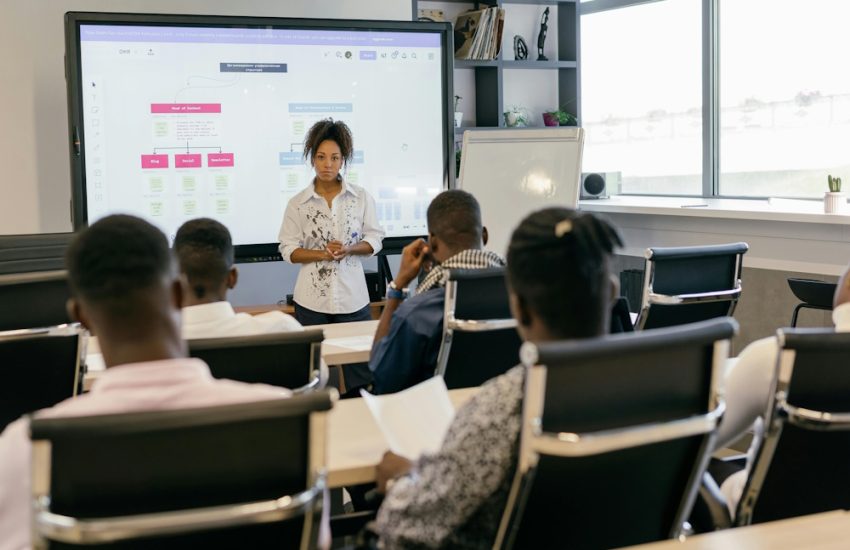
Picture this: a 19-year-old deaf woman in Mandera has just heard — through a neighbour who heard it through a community WhatsApp group — that there is a digital skills training programme nearby. She wants to go. She is curious, ambitious, and more than capable. But when she arrives, every session is delivered verbally. The trainer speaks fast. There is no interpreter. The course materials are in written English. No one in the room knows Kenyan Sign Language. She sits through half a day, understands almost nothing, and does not come back.
The training programme was not designed to exclude her. Nobody intended it. But intention and outcome are very different things — and in Kenya’s deaf community, the gap between them has been widening for decades.
We are at a significant moment. Kenya has passed landmark legislation that signals real political will to change this. But legislation, however well-crafted, does not sit in a training room. It does not adapt a curriculum. It does not find a KSL interpreter for a rural cohort in Busia. It does not make a digital platform readable by someone whose first language is not English or Kiswahili, but sign. That work falls to ground-level implementing partners. And it needs to start now.
What the Laws Actually Say — and Why That Matters
Let’s be clear: the recent legislative progress in Kenya is genuinely significant, and it deserves recognition.
The Kenya Sign Language Bill (Senate Bill No. 9 of 2023), introduced by Senator Crystal Asige and co-sponsored by Hon. Millie Odhiambo-Mabona, gives constitutional weight to KSL as Kenya’s third official national language, alongside English and Kiswahili. If fully enacted, it will require public and private schools to offer KSL as a subject, establish a national system for KSL interpretation, create a sign language council to regulate interpreter standards, and oblige telecommunications companies to make their services accessible to people with hearing impairments (Parliament of Kenya, 2023). A companion bill — the Kenya Sign Language Bill No. 1 of 2024 — goes further still, proposing a KSL Council with formal regulatory powers and explicitly recognising tactile KSL for Deafblind Kenyans (Oraro & Company Advocates, 2025).
Then, in May 2025, the Persons with Disabilities Act 2025 came into force — replacing the outdated 2003 Act and representing, as legal analysts have described it, a fundamental overhaul of Kenya’s disability rights framework. The Act prohibits discrimination in employment, education, transport, and public services. It requires all employers with 20 or more employees to ensure that at least 5% of their workforce are persons with disabilities. It mandates accessible information formats, and it places enforceable obligations on public and private institutions that, for the first time, carry real penalties for non-compliance (Cliffe Dekker Hofmeyr, 2025; CMS Law, 2025).
Alongside these, the Persons with Disabilities Act 2025 requires television stations to carry KSL insets on news and educational content, and directs national and referral hospitals to employ KSL interpreters (WANGO/The Star, 2025). Kenya’s new AI Strategy 2025–2030 also explicitly includes disability as a dimension of inclusive AI development — signalling that the digital future is, at least on paper, being designed with deaf Kenyans in mind (EnableMe Kenya, 2025).
This is meaningful progress. It took advocacy, courage, and years of sustained effort by deaf rights leaders and civil society organisations to get here. It should be celebrated.
And it is not enough.
The Implementation Gap Is Where People Fall Through
Here is what no Act of Parliament can change on its own: the lived reality of a deaf young person in Turkana or Kwale who wants to learn digital skills but has no access to a trained KSL interpreter within 100 kilometres of where they live.
Consider the numbers. According to the World Federation of the Deaf, just 5% of deaf people worldwide have access to sign language interpretation (WFD, 2019, as cited in Development Pathways, 2023). Kenya almost certainly mirrors — or falls below — this global figure, given persistent resource constraints in marginalised counties. Fewer than 10% of deaf children in Kenya have access to quality education, compared to 85.4% of hearing children (African Disability Rights Yearbook, 2015, as cited in Development Pathways, 2023). And the National Council for Persons with Disabilities (NCPWD), while commendably running KSL training for civil servants, operates across just eight centres nationwide — Nairobi, Isiolo, Kakamega, Kisii, Nyeri, Nakuru, Kisumu, and Mombasa — leaving vast swathes of the country completely uncovered (NCPWD, 2024).
Meanwhile, Kenya’s deaf community is not small or peripheral. Over two million Kenyans are deaf or hard of hearing (Michael, 2024). Many of them are young. Many of them are in exactly the counties — the ASALs, the northern corridor, the coastal hinterland — where Tech4G operates.
Even the KSL Bill itself has been critiqued by deaf community advocates for having gaps: inconsistent definitions, inadequate provisions for interpreter accreditation, and qualifications criteria for sign language registrars that don’t yet ensure the quality the community needs (Michael, 2024). The 2025 Act, progressive as it is, faces the same challenge every landmark Kenyan disability law has faced before it — the 2003 Act is widely cited as having failed not for want of good text, but for want of effective implementation (Manwa Advocates, 2025).
Laws need legs. And in Kenya’s underserved counties, those legs are local organisations with community roots, operational experience, and the trust of the people they serve.
So What Does Genuinely Inclusive Digital Training Actually Look Like?
This is where the conversation usually gets vague. “Accessible training” becomes a checkbox. “KSL-inclusive content” becomes a bullet point on a funder proposal. We want to be concrete — because concrete is the only kind of commitment that changes anyone’s life.
1. KSL interpreters embedded in training delivery — not added as an afterthought
A KSL interpreter at the back of a room, brought in for the last 20 minutes of a session, is not inclusion. It is the appearance of inclusion. Genuine KSL-accessible training means that a qualified interpreter is present for the full duration of every session, that they have been briefed on the digital content in advance, and that they are positioned where every deaf participant can see them clearly throughout.
This requires advance planning, adequate budgets for interpreter fees, and — critically — a pipeline of qualified KSL interpreters who can deliver in community settings, not just courtrooms and hospitals. Organisations like Tech4G must actively invest in identifying and supporting KSL interpreters who are willing and able to work in underserved counties where demand has traditionally been invisible.
2. Content redesigned, not just translated
There is a common misunderstanding that making content accessible to deaf learners means adding subtitles or captions. Captions help — but they are not sufficient for learners whose primary language is KSL, not written English. The cognitive load of reading English captions while also trying to absorb new digital concepts is significant, particularly for learners who have had limited access to formal education.
KSL-accessible digital training content means: video-based modules narrated in KSL by deaf educators or skilled interpreters; visual diagrams and step-by-step walkthroughs that rely minimally on dense text; glossaries of digital terms translated into KSL signs (including newly coined signs for concepts that don’t yet have established KSL equivalents); and assessments that allow learners to demonstrate understanding through visual and practical means, not just written responses.
Research on AI-driven KSL tools offers real promise here. A 2023–2024 project developing an open-access AI dataset for KSL translation — involving 48 teachers of deaf learners and 400 deaf learners — is building the foundation for technology that could make KSL-adapted digital content scalable in ways that manual translation alone cannot achieve (Arxiv, 2024). Signvrse’s Terp 360, founded by 24-year-old Kenyan Elly Savatia and recognised with the Kenya Presidential Innovation Award, uses motion-captured avatars to convert text and speech into KSL — a tool that could eventually be integrated into digital training platforms to make content accessible without requiring a human interpreter to be present for every single interaction (Africanews, 2025).
These technologies are not yet perfect, and they are not yet accessible everywhere. But they point to a direction that implementing organisations must be actively building toward — not waiting for technology companies to hand them ready-made solutions.
3. Deaf-led design, not hearing-led assumptions
One of the most consistent findings in disability inclusion research is that programmes designed for deaf communities without the meaningful involvement of deaf people in the design process tend to miss the mark in ways that are hard to predict from the outside.
What motivates a deaf young person to pursue digital skills? What are the specific employment pathways that make most sense for deaf youth in their community? What are the social dynamics that make a training environment feel safe or threatening for a deaf participant? What do deaf women in Mandera experience that is different from deaf men, or from deaf youth in Nairobi?
These are not questions that any hearing programme designer — however well-intentioned — can answer alone. Inclusive digital training means bringing deaf people into the design process as genuine co-creators. It means employing deaf trainers and deaf Community Digital Champions wherever possible, so that participants see themselves reflected in the people delivering the programme. It means feedback mechanisms that are genuinely accessible to deaf participants — not just post-training surveys written in English.
4. Connecting digital skills to real employment pathways — including those mandated by law
This is where the new legislative landscape becomes directly useful. The PWDs Act 2025 mandates a 5% employment quota for persons with disabilities in organisations with 20 or more staff (Njaga Advocates, 2025). This is a demand signal. Employers are now legally obliged to find qualified candidates with disabilities. The question is whether those candidates exist — and whether they have the digital skills to compete.
Tech4G’s role is to help answer that question with a yes. By connecting KSL-inclusive digital training directly to the employment landscape shaped by the new legislation, we can position deaf graduates of our programmes as ready, capable candidates for roles that employers are now legally required to fill. That means building relationships with employers, translating the new legal obligations into concrete recruitment pipelines, and ensuring that our graduates are not just digitally literate in the abstract, but prepared for the specific digital environments they will encounter in the workplace.
The future of work is digital. The World Economic Forum estimates that 83 million jobs will be displaced globally by automation, while 69 million new ones will be created, with 44% of workers needing to retrain in entirely new skill areas within the next five years (World Economic Forum, 2023). Deaf youth who are locked out of digital skills training today are not just being excluded from current opportunities — they are being excluded from the economy of the future. That is a loss that no amount of well-intentioned legislation can reverse if it is not matched by implementation on the ground.
The Role of Ground-Level Partners
Here is what Tech4G knows from operating across 23 counties and delivering 45 programmes: no law, no policy framework, and no national strategy reaches a deaf teenager in a remote community without someone physically present in that community, building trust, adapting delivery, solving problems in real time, and refusing to give up when the internet cuts out or the interpreter is late or the participant’s father didn’t want her to come.
That is the work of implementing partners. It is unglamorous, slow, and expensive relative to the visibility it generates. But it is the work that actually changes things.
Research on digital inclusion initiatives has consistently found that co-designing solutions with affected communities from the very start — rather than consulting them after decisions have been made — is a game-changer in enabling wider participation (Digital Future Society, 2020). Tech4G is committed to this principle, not as a procedural box to tick, but as a genuine belief that the people closest to a problem are the ones who understand it most clearly.
We also know that this kind of work requires sustained investment — not one-off project funding, but partnerships that last long enough for trust to develop, for capacity to build, and for deaf youth to move from training into employment. The legislative moment Kenya is in right now creates an opportunity. The PWDs Act 2025 creates legal obligation. The KSL Bills create formal recognition. But the bridge between law and lived reality is built by organisations who show up, day after day, in the communities that policy documents too often only mention in passing.
What We Are Asking For
We are not asking for sympathy. Kenya’s deaf community is not asking for charity. What is being asked for — by deaf advocates, by disability rights organisations, by the community itself — is what the Constitution promised and what the new legislation has reaffirmed: equal participation. Full inclusion. A future of work that does not require you to hear in order to contribute.
Tech4G is committed to building that future, one KSL-accessible training programme at a time. But we cannot do it alone. We need funders who understand that inclusive programming costs more upfront and delivers more downstream. We need technology partners who will develop tools with deaf users, not just for them. We need government agencies who will translate the new legislative mandates into procurement criteria that reward genuine inclusion over performative accessibility.
And we need, above all, the continued courage and advocacy of Kenya’s deaf community — whose voices, in whatever language they use to express them, are the reason any of this progress exists at all.
References
- African Disability Rights Yearbook. (2015). Disability rights in Africa: Annual review. University of Pretoria.
- Africanews. (2025, August 11). Kenyan startup Signvrse pioneers AI-powered sign language translation. https://www.africanews.com/2025/08/11/kenyan-startup-signvrse-pioneers-ai-powered-sign-language-translation/
- Arxiv. (2024). Kenyan Sign Language (KSL) dataset: Using artificial intelligence (AI) in bridging communication barrier among the deaf learners. https://arxiv.org/pdf/2410.18295
- Cliffe Dekker Hofmeyr. (2025, October 15). A landmark shift in rights, compliance, and inclusion with Kenya’s new Persons with Disabilities Act. https://www.cliffedekkerhofmeyr.com
- CMS Law. (2025, September 8). Inclusion at work: Key employment law shifts under Kenya’s new Persons with Disabilities Act, 2025. https://cms.law/en/ken/news-information/inclusion-at-work-key-employment-law-shifts-under-kenya-s-new-persons-with-disabilities-act-2025
- Development Pathways. (2023, November 13). Echoes of empowerment: Fostering social protection for the deaf in Kenya. https://www.developmentpathways.co.uk/blog/echoes-of-empowerment-fostering-social-protection-for-the-deaf-in-kenya/
- Digital Future Society. (2020). Bridging digital divides: A framework for digital cooperation. https://digitalfuturesociety.com/app/uploads/2020/04/THINK_TANK_I4_BRIDGING_DIGITAL_DIVIDE_EN.pdf
- EnableMe Kenya. (2025, October 28). Why Kenya’s technology future must include persons with disabilities. https://www.enableme.ke/en/article/why-kenya-s-technology-future-must-include-persons-with-disabilities-12810
- Manwa Advocates. (2025, August 26). The Persons with Disabilities Act 2025: A transformative step for inclusion in Kenya. https://manwaadvocates.com/the-persons-with-disabilities-act-2025-a-transformative-step-for-inclusion-in-kenya/
- Michael, A. (2024, April 4). Kenyan Sign Language Bill 2023 needs major fixes for deaf rights. Nation Africa. https://nation.africa/kenya/blogs-opinion/blogs/ashura-kenyan-sign-language-bill-2023-needs-major-fixes-for-deaf-rights-4579520
- National Council for Persons with Disabilities. (2024). Expression of interest for Kenya Sign Language training. https://ncpwd.go.ke/ksl-training/
- Njaga Advocates. (2025, October 2). Key employer responsibilities and disability rights under Kenya’s Persons with Disabilities Act 2025. https://njagaadvocates.com/key-employer-responsibilities-and-disability-rights-under-kenyas-persons-with-disabilities-act-2025/
- Oraro & Company Advocates. (2025, March 5). The Kenya Sign Language Bill 2024. https://www.oraro.co.ke/the-kenya-sign-language-bill-2024/
- Parliament of Kenya. (2023). The Kenyan Sign Language Bill, 2023 (Senate Bill No. 9 of 2023). https://www.parliament.go.ke/sites/default/files/2023-03/The%20Kenyan%20Sign%20Language%20Bill,%202023.pdf
- WANGO/The Star. (2025, September 19). Kenya’s KSL moment: From Nairobi’s global stage to everyday service. https://www.the-star.co.ke/opinion/star-blogs/2025-09-19-wango-kenyas-ksl-moment-from-nairobis-global-stage-to-everyday-service
- World Economic Forum. (2023). The future of jobs report 2023. https://www.weforum.org/publications/the-future-of-jobs-report-2023/
- World Federation of the Deaf. (2019). WFD position paper on accessibility: Sign language interpreting and translation and technological developments. https://wfdeaf.org/
