
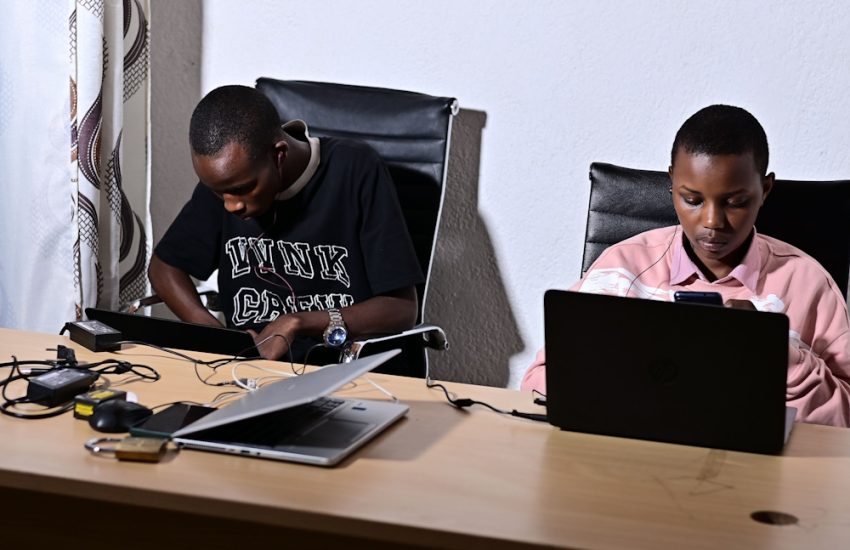
There’s a teenager in Mandera right now who is sharp, curious, and full of potential. She has probably never touched a laptop. She may not know what cloud computing means, or that somewhere across the country, a young man her age in Nairobi is already building apps and freelancing for clients abroad. The distance between them isn’t just geographical — it’s digital. And it is growing every single day.
This is the gap that Technology For Growth (Tech4G) was built to close.
The World Is Moving. Not Everyone Got the Memo.
We talk a lot about Kenya’s digital revolution — and rightly so. Mobile money changed how the country does business. Nairobi’s startup scene has earned its reputation as “Silicon Savannah.” Kenya consistently ranks among Africa’s top digital performers. But beneath those headline numbers, a different story is playing out.
According to a 2025 joint survey by the Communications Authority of Kenya (CA) and the Kenya National Bureau of Statistics (KNBS), mobile phone ownership in counties like West Pokot stands at just 29%, Turkana at 29.4%, and Marsabit at 34.8% — compared to Nairobi’s near-universal access. The same report found that ICT adoption is strongly linked to income, education, and access to electricity — three things that underserved counties have in far shorter supply (Communications Authority of Kenya & Kenya National Bureau of Statistics, 2025).
The consequence? Young people in these regions are not just behind — they are being actively excluded from an economy that is restructuring around digital skills at a speed that waits for no one.
The World Economic Forum’s Future of Jobs Report puts it starkly: 83 million jobs will be displaced globally by automation, while 69 million new ones will be created — and 44% of workers will need to retrain in entirely new skills within the next five years (World Economic Forum, 2023). In sub-Saharan Africa, where nearly three-quarters of young adults are already stuck in informal, insecure work (International Labour Organization, 2024), this transformation is not a distant concern. It is already here.
Why Tech4G Exists
Tech4G didn’t emerge from a boardroom strategy session. It grew out of something much more human — a recognition, accumulated over years of working in Kenya’s engineering and technology sectors, that the country’s most capable young people were being systematically overlooked.
Born from Viscar Industrial Capacity Ltd, which has spent over 16 years delivering engineering technology solutions across East Africa, Tech4G carries with it a deep understanding of what happens when training reaches the right hands. It works. When it doesn’t reach those hands — when a young person in Garissa or Turkana or Kwale never gets the chance to learn — the loss is not only theirs. It belongs to all of us.
Tech4G’s mission is straightforward, even if the work is not: to provide mentorship, inspire innovation, support technological entrepreneurship, and equip marginalised and vulnerable communities with relevant digital skills to earn sustainable livelihoods.
Its vision is even simpler — and perhaps more radical: a world where all people are digitally competent and enjoying the benefits of the digital economy. Not some people. Not people in cities. All people.
Who Tech4G Is Showing Up For
Tech4G is clear about who it serves, and that clarity matters. The organisation explicitly targets:
- Women and girls, who face compounded barriers — cultural, economic, and infrastructural — that make digital exclusion a gendered issue as much as a geographic one.
- Youth, particularly those who have left formal education without employable skills in a market that has moved on without them.
- Persons with disabilities, who face some of the highest rates of digital exclusion globally and are often invisible in mainstream skills programmes.
- Communities in marginalised regions, including Wajir, Mandera, Samburu, Turkana, Kilifi, Kwale, and Garissa — places where food poverty, limited infrastructure, and geographic remoteness compound one another.
Research consistently shows that these exclusions are not accidents. They are the predictable result of designing digital systems around the most connected, most resourced, most visible populations — and hoping the rest will eventually catch up. They don’t. Not without deliberate intervention.
A 2023 INCLUDE Platform report on digital skills for youth employment in Africa found that digital skills are essential for employability across IT, telecommunications, and finance — and that targeted training programmes can meaningfully close the skills gap and boost economic participation for marginalised youth (Fox & Signé, 2021; Mhlongo et al., 2024, as cited in Exploring the Potential of Digital Technology in Addressing Youth Employment in Africa, 2023).
The Three Pillars of Tech4G’s Work
1. Knowledge and Research
Tech4G invests in data and evidence — because good intentions without good information produce interventions that miss the mark. The organisation conducts research, contributes to national dialogue on technology policy, and publishes reliable reports on technology and growth. The aim is to become a genuine authority on what is actually happening on the ground in marginalised communities — not what urban-based policymakers assume is happening.
This matters because, as a 2023 review from the Centre for Intellectual Property and Information Technology Law (CIPIT) at Strathmore University noted, many of Kenya’s most underserved regions remain “data deserts” — places where the lack of information perpetuates the lack of investment in a self-reinforcing cycle (CIPIT, 2023).
2. Innovation and Entrepreneurship
Tech4G doesn’t just teach people how to use technology. It teaches people how to build with it. By supporting digital entrepreneurship, the organisation helps young people become makers and creators — not just consumers — of the digital economy. This is critical. Research from sub-Saharan Africa has consistently shown that digital platforms, when paired with entrepreneurship training, enable young people to build viable online businesses, generate income, and create employment for others in their communities (Apeh et al., 2023; Akanle & Omotayo, 2019).
3. Mentorship and Employability
Perhaps the most human of Tech4G’s pillars is its commitment to mentorship. The organisation ensures that experienced professionals are available to guide young people through real decisions — not just abstract lessons. This matters especially in communities where young people have few visible role models working in the technology sector. Seeing that a path exists is often the first step to believing you can walk it.
What the Evidence Says
The research backing Tech4G’s approach is unambiguous.
A 2024 study published in the Wukari International Studies Journal found that Kenya achieved a 24% improvement in youth digital employment between 2017 and 2023 — directly linked to sustained investment in digital skills ecosystems. Countries that made similar investments climbed in global digital competitiveness rankings; those that didn’t fell further behind (Wukari International Studies Journal, 2025).
At the macroeconomic level, a 10% increase in broadband penetration has been shown to yield a 1.4% rise in GDP in developing nations (Khalil et al., 2009, as cited in Nuvoni Centre for Innovation Research, 2023). Digital access is not a luxury. It is infrastructure — as foundational as roads or electricity.
And yet, as the Daily Nation reported in April 2026, affordability, infrastructure gaps, and limited digital skills remain the three persistent barriers that prevent Kenya’s impressive national averages from translating into genuine inclusion at the community level (Daily Nation, 2026).
Tech4G is working on all three.
A County-by-County Future
The hardest thing about inequality is how invisible it can be from the outside. When a national statistic says “65% of Kenyans have internet access,” it is easy to feel like things are basically fine. But for the 35% who don’t — and for the young person in Mandera who has never seen a functioning computer — that statistic means nothing.
Tech4G chooses not to look away from that reality. Instead, it builds in it — county by county, community by community, young person by young person.
In just two years of operation, Tech4G has already delivered 45 programmes across 23 counties. The numbers will grow. But more importantly, so will the confidence, the skills, and the economic participation of young people who were told — implicitly, by the systems around them — that this digital future wasn’t meant for them.
It is. And Tech4G is here to prove it.
Be Part of the Change
Whether you are a technology company, a development organisation, a government agency, or simply someone who believes that every young person deserves a fair shot, there is a role for you in this work.
📧 Get in touch: [email protected]
📍 Kasneb Towers, 10th Floor, Matumbato Road, Upper Hill, Nairobi
🌐 technology4growth.org
🤝 Partner with us
References
- Akanle, O., & Omotayo, A. (2019). Digital incubation and youth entrepreneurship in Nigeria. Journal of African Studies and Development, 11(3), 32–41.
- Apeh, E. T., Nwosu, C., & Obi, J. (2023). Digital entrepreneurship and Nigerian youth: Opportunities in the online economy. African Journal of Economic and Management Studies, 14(2), 119–134.
- Communications Authority of Kenya & Kenya National Bureau of Statistics. (2025). Analytical report on ICT based on the 2023/24 Kenya Housing Survey. Communications Authority of Kenya. https://www.ca.go.ke/urban-rural-digital-divide-hinders-ict-uptake-joint-ca-and-knbs-survey-shows
- Centre for Intellectual Property and Information Technology Law. (2023). Kenya’s digital deserts. Strathmore University. https://cipit.strathmore.edu/kenyas-digital-deserts/
- Daily Nation. (2026, April 19). How bold bet on youth will bridge digital divide. Nation Media Group. https://nation.africa/kenya/blogs-opinion/blogs/how-bold-bet-on-youth-will-bridge-digital-divide-5428404
- Fox, L., & Signé, L. (2021). Digital technology — a pathway for Africa’s youth to access the future of work. Brookings Institution.
- Howard, J. (2023). Digital skills gaps and African youth employability: Challenges and policy responses. Journal of International Development, 35(4), 781–799.
- International Labour Organization. (2024). Global employment trends for youth 2024. ILO. https://www.ilo.org/publications/major-publications/global-employment-trends-youth-2024
- Khalil, M., Kenny, C., & Narimatsu, J. (2009). Broadband and economic growth: A worldwide study. World Bank.
- Mhlongo, S., Dube, B., & Moyo, T. (2024). Closing the digital skills gap: Targeted training programmes and ICT employment in South Africa. South African Journal of Information Management, 26(1), 1–12.
- Nuvoni Centre for Innovation Research. (2023). Unearthing the digital divide among the urban poor in Kenya’s informal settlements. https://nuvoniresearch.org
- Wukari International Studies Journal. (2025). Digital skills development, youth employment and economic competitiveness in Africa. https://wissjournals.com.ng/index.php/wiss/article/view/801
World Economic Forum. (2023). The future of jobs report 2023. WEF. https://www.weforum.org/publications/the-future-of-jobs-report-2023/
